Questions parents ask
Straight answers to what parents ask us most, built on how children learn, with the studies linked.
Each page starts with a short answer you can use today. Then it explains why it works, with every study, verse and hadith linked to its source, and gives a routine to follow, what changes with age and the mistakes to avoid. Pick a topic, or start with the question closest to your child’s age.
Arabic
What’s the best way to teach my child Arabic at home?
Ten minutes a day, one letter at a time: the routine, why it works, and what changes with age.
Read the answerMy child knows the Arabic letters. How do I teach them to read words?
Blending sounds, joining shapes and a week of first words, for ages 5 to 9.
Read the answerHow do I teach my child the Arabic short vowels (harakat)?
Fatha, kasra, damma and the rest: the order, a game for each and a six-day plan.
Read the answerHow do I get my 4- to 6-year-old ready to write Arabic?
Strong fingers, right-to-left strokes, finger tracing and a first letter, through play.
Read the answerHow do I teach my 7- to 10-year-old to write Arabic by hand?
Joining, the line, and a copy, dictate, recall routine for ten minutes a day.
Read the answerHow do I help my child say the Arabic sounds English doesn’t have?
Where each sound lives, a trick for each one and listening games for the ear.
Read the answerShould my child learn standard Arabic (fusha) or our dialect first?
Why it’s not either-or, what studies of Arabic-speaking children show, and a plan by age.
Read the answerWhich Arabic words should I teach my toddler first?
About 30 everyday words with vowel marks, and how to use them without flashcards.
Read the answerHow do I keep my 4- to 7-year-old excited about learning Arabic?
Games, progress charts, the right praise, and why promised prizes backfire.
Read the answerMy 8- to 12-year-old is losing interest in Arabic. How do I keep them going?
Choices, real reasons, projects with family and praise that keeps them trying.
Read the answerIs it too late for my 10-year-old to start learning Arabic?
What older beginners do faster, what’s harder, and a plan for the first weeks.
Read the answerHow can my child learn Arabic from cartoons, songs and apps without too much screen time?
Watch together, call family, play songs without a screen, and pick apps that make kids talk.
Read the answerHow do I teach my child Arabic numbers?
Counting words, the digits ٠ to ٩, a board game that works and the mix-ups to watch for.
Read the answer
The Quran
How do I teach my 4- to 6-year-old to read the Quran?
Letters and sounds first, then short vowels and joining: the qaida steps, a few minutes a day.
Read the answerHow do I teach my 7- to 10-year-old to read the Quran?
From the qaida to the mushaf: listen, reread, get checked, and add tajweed one rule at a time.
Read the answerHow do I help my 3- to 5-year-old memorize short surahs?
By ear: one surah, one reciter, the same moments every day, and lines your child finishes.
Read the answerHow do I help my 6- to 9-year-old memorize short surahs?
New, recent, old: a small new piece and a steady review, every day.
Read the answerHow can my 10-year-old memorize surahs and review them on their own?
Set a target, self-test, mark weak spots, rotate review: you become the coach.
Read the answerWhich surahs should my child learn first, and in what order?
Al-Fatiha, then Juz Amma from An-Nas backwards: the order, the reasons and the lengths.
Read the answerWhat is the Noorani Qaida, and does my child need it before the Quran?
What the qaida teaches, lesson by lesson, how long it takes, and when you can skip the book.
Read the answerHow can I teach my child the meaning of the Quran, not just the words?
One idea per surah, a few Arabic words, the story behind it, and a question to talk about.
Read the answerHow do I teach tajweed to my child?
One rule at a time: hear it, find it in a known surah, say it, get it checked.
Read the answerHow do I tell my kids the stories of the prophets, like Musa, Yusuf, Nuh and Yunus?
From the Quran first: Nuh, Yusuf, Musa and Yunus, with verses, questions and a free quiz.
Read the answer
The Prophet Muhammad ﷺ
How do I tell my 3- to 5-year-old about the Prophet Muhammad ﷺ?
A few simple facts and short true stories of his kindness, told often.
Read the answerHow do I tell my 6- to 9-year-old the story of the Prophet Muhammad ﷺ?
His life in eight chapters, one a week, each with one event, one lesson and its source.
Read the answerHow do I teach my 10- to 12-year-old the life of the Prophet Muhammad ﷺ?
A real biography, a timeline with sources, lessons, and how to check a story.
Read the answerWhy do we say ﷺ after the Prophet’s name, and how do I explain it to my kids?
What it means, where it comes from, and how to explain it to children.
Read the answerWhat are true stories of the Prophet’s ﷺ kindness I can tell my kids?
Ten short stories from the hadith, each with its source, and two famous ones that have none.
Read the answerWhy don’t Muslims draw the Prophet ﷺ, and how do I explain it to my child?
What scholars say, where they differ, and what to tell a child who asks what he looked like.
Read the answerHow do I teach my child the Prophet’s ﷺ everyday habits (sunnah)?
Twelve small sunnahs with their hadith, one at a time, tied to a moment of the day.
Read the answer
Prayer, Allah and everyday Islam
How do I teach my 3- to 6-year-old to pray?
Ages 3–6: a mat of their own, copying you, and no corrections yet.
Read the answerHow do I teach my 7- to 9-year-old the steps of prayer?
Seven to nine: one step at a time, shown before it’s explained.
Read the answerHow do I get my child to pray regularly from age 10?
Ten and up: fixed moments, their own plan, and no nagging.
Read the answerHow do I teach my child wudu?
Side by side at the sink, one step a day, right side first.
Read the answerHow do I teach my kids the five pillars of Islam?
Five pillars, five things to do together, one a week.
Read the answerHow do I explain Allah to my 3- to 5-year-old?
Ages 3–5: short true sentences about what they can see and feel.
Read the answerHow do I answer my 6- to 9-year-old’s questions about Allah?
Ages 6–9: His names, real answers, and trust on hard days.
Read the answerHow do I teach my child everyday duas?
One dua a week, tied to its moment, with Arabic, meaning and source.
Read the answerHow do I teach my child Islamic manners (adab) at home?
One manner a week, practiced in real moments, modeled by you.
Read the answerHow do I teach my child about Islamic history and Muslim scholars?
One person a week, told as a story, honest about the facts.
Read the answer
Ramadan and Eid
How do I explain Ramadan to my 3- to 5-year-old?
One sentence to say, the moon to watch and a job at iftar: Ramadan for the youngest.
Read the answerHow do I explain Ramadan to my 6- to 9-year-old?
The Quran’s reason in their words, seven questions for the first week, and talks at iftar.
Read the answerAt what age should my child start fasting, and how do we practice?
A duty at puberty, practice before it: the Companions’ way, a step-by-step plan and the warning signs.
Read the answerHow do I explain Laylat al-Qadr to my kids?
The story, why the date is hidden, Surah Al-Qadr verse by verse, and five odd nights that keep bedtime.
Read the answerHow do I explain the two Eids to my children?
Eid al-Fitr and Eid al-Adha side by side, Ibrahim’s story told gently, and the Eid Sunnah for kids.
Read the answerHow do we make Eid special for our kids when it’s a school day?
Home or school, what to write to the teacher, and a plan for Eid week that works abroad.
Read the answerHow do I explain zakat and sadaqah to my kids?
Sadaqah, zakat and zakat al-fitr in simple words, with a five-day plan to prepare zakat al-fitr together.
Read the answer
The Islamic months
How do I teach my child the twelve Islamic months?
A chant for the names, the new moon as your calendar, and one story for every month.
Read the answerWhy does Ramadan move every year, and how do I explain it to my kids?
The moon calendar in plain words, the 11-day arithmetic, and a month of moon-watching to make it real.
Read the answerHow do I explain the Hijra and the Islamic New Year to my kids?
The journey in seven scenes, why year 1 is the Hijra, and how to mark the day.
Read the answerHow do I explain Ashura to my children?
Musa and the sea, the fast of thanks, and how children joined in, with a source for every part.
Read the answerHow do I explain Hajj and Dhul-Hijjah to my kids?
The family story behind Hajj, its days in order, and how children at home take part.
Read the answerHow do I tell my kids the story of Isra’ and Mi‘raj?
The Night Journey from the Quran and sahih hadith, and its gift: the five daily prayers.
Read the answer
Raising a bilingual child
How do I raise a bilingual baby in Arabic and English (ages 0–3)?
Why the amount of Arabic matters most, who should speak it, and what to expect by age.
Read the answerHow do I keep my child bilingual in Arabic and English once school starts (ages 4–7)?
Protect Arabic time, get your child speaking it, and start reading it, ten minutes a day.
Read the answerHow do I keep my 8- to 12-year-old speaking and reading Arabic?
Real uses for Arabic, a reading habit with vowel marks, and a say in how they learn.
Read the answerMy child understands Arabic but answers in English. What can I do?
Why it happens, five gentle replies that invite Arabic, and a six-day plan.
Read the answerWill learning Arabic confuse my child or delay their English?
Five common worries, what the studies found, and where the evidence stops.
Read the evidenceHow do we keep Arabic alive when only one parent speaks it?
What “one parent, one language” can and can’t do, and the other parent’s part.
Read the answerHow do I choose an Arabic weekend school or tutor for my child?
What to look for in a lesson, the questions to ask, the red flags, and the daily follow-up.
Read the answerHow can grandparents back home help teach my kids Arabic over video calls?
Why live video calls work, ideas for each age, and a note to send to the grandparents.
Read the answer
Everything in one book
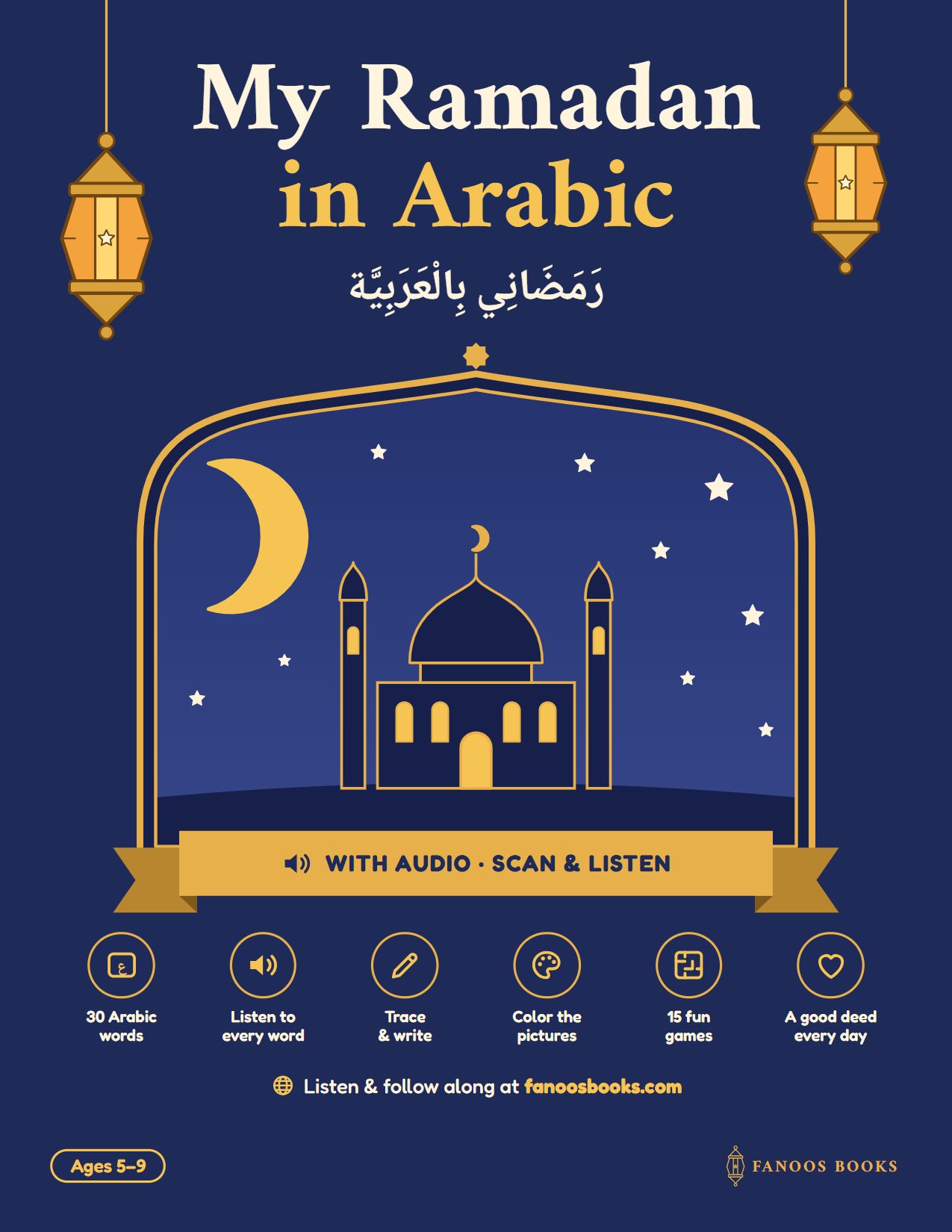
My Ramadan in Arabic puts the words, the phrases, the good deeds, the games and the quiz together, one day at a time.
See the book