Arabic for kids: how to teach your child at home
13 answers for parents, from a toddler’s first words to a 10-year-old starting from scratch, each with its routine and its sources.
A little Arabic every day works better than a long lesson once a week. Ten minutes is enough when it is the same ten minutes each day: one letter or one word, heard from a native speaker, said aloud, traced and played with, and your child checking their own answers. You don’t need to speak Arabic yourself: a steady routine and a good recording do most of the work. Our main answer sets out that routine, step by step.
What changes with age is what goes into those ten minutes. Toddlers learn the words they can see, touch and ask for, used in real moments, with no quizzing. From about 4, children get their hands ready for writing with play dough, sand and big strokes, and meet the letters with their sounds. Between 5 and 7 come the short vowels, fatha, kasra and damma, and the first blended words, read right to left with a finger under the line. From 7, joined handwriting and dictation make sense, and from 8 the real question is motivation: choices and real reasons to use Arabic work better than stickers.
Starting late is not a problem. A 10-year-old can learn the letters in two or three months, and older beginners often make faster progress at first than younger ones. Families also ask whether to start with standard Arabic (fusha) or their dialect: both, for different jobs. Screens help most as a source of Arabic voices you watch together, not as the teacher.
Each answer below opens with a short answer you can use today, then gives a routine, what changes with age, the mistakes to avoid and every study it relies on, linked. Start with the first one, or with your child’s age.
Questions parents ask: Arabic for kids
13 questions, youngest first. Each opens with a short answer, then a routine, what changes with age and the sources.
- Start here
What’s the best way to teach my child Arabic at home?
Ten minutes a day, one letter at a time: the routine, why it works, and what changes with age.
Read the answer -
Which Arabic words should I teach my toddler first?
About 30 everyday words with vowel marks, and how to use them without flashcards.
Read the answer -
How do I teach my child Arabic numbers?
Counting words, the digits ٠ to ٩, a board game that works and the mix-ups to watch for.
Read the answer -
How do I get my 4- to 6-year-old ready to write Arabic?
Strong fingers, right-to-left strokes, finger tracing and a first letter, through play.
Read the answer -
How do I keep my 4- to 7-year-old excited about learning Arabic?
Games, progress charts, the right praise, and why promised prizes backfire.
Read the answer -
How do I teach my child the Arabic short vowels (harakat)?
Fatha, kasra, damma and the rest: the order, a game for each and a six-day plan.
Read the answer -
My child knows the Arabic letters. How do I teach them to read words?
Blending sounds, joining shapes and a week of first words, for ages 5 to 9.
Read the answer -
How do I help my child say the Arabic sounds English doesn’t have?
Where each sound lives, a trick for each one and listening games for the ear.
Read the answer -
How do I teach my 7- to 10-year-old to write Arabic by hand?
Joining, the line, and a copy, dictate, recall routine for ten minutes a day.
Read the answer -
My 8- to 12-year-old is losing interest in Arabic. How do I keep them going?
Choices, real reasons, projects with family and praise that keeps them trying.
Read the answer -
Is it too late for my 10-year-old to start learning Arabic?
What older beginners do faster, what’s harder, and a plan for the first weeks.
Read the answer -
Should my child learn standard Arabic (fusha) or our dialect first?
Why it’s not either-or, what studies of Arabic-speaking children show, and a plan by age.
Read the answer -
How can my child learn Arabic from cartoons, songs and apps without too much screen time?
Watch together, call family, play songs without a screen, and pick apps that make kids talk.
Read the answer
Free to use with your child
Pages already on this site that go with these answers, free for home and the classroom.
- Alphabet
The Arabic alphabet for kids
All 28 letters with their shapes, sounds and words to find them in.
See the letters - Word list
30 Ramadan words in Arabic
Every word of the month with pronunciation, letters and meaning, in one table.
See the words - Free printables
Coloring pages, charts and trackers
Ramadan coloring pages with Arabic words to trace, a good deeds chart, a moon tracker and alphabet worksheets.
Print them - Guide
How to teach your child Arabic in Ramadan
A ten-minute daily routine for one word a day, from the crescent to Eid, even if you don’t speak Arabic.
Read the guide
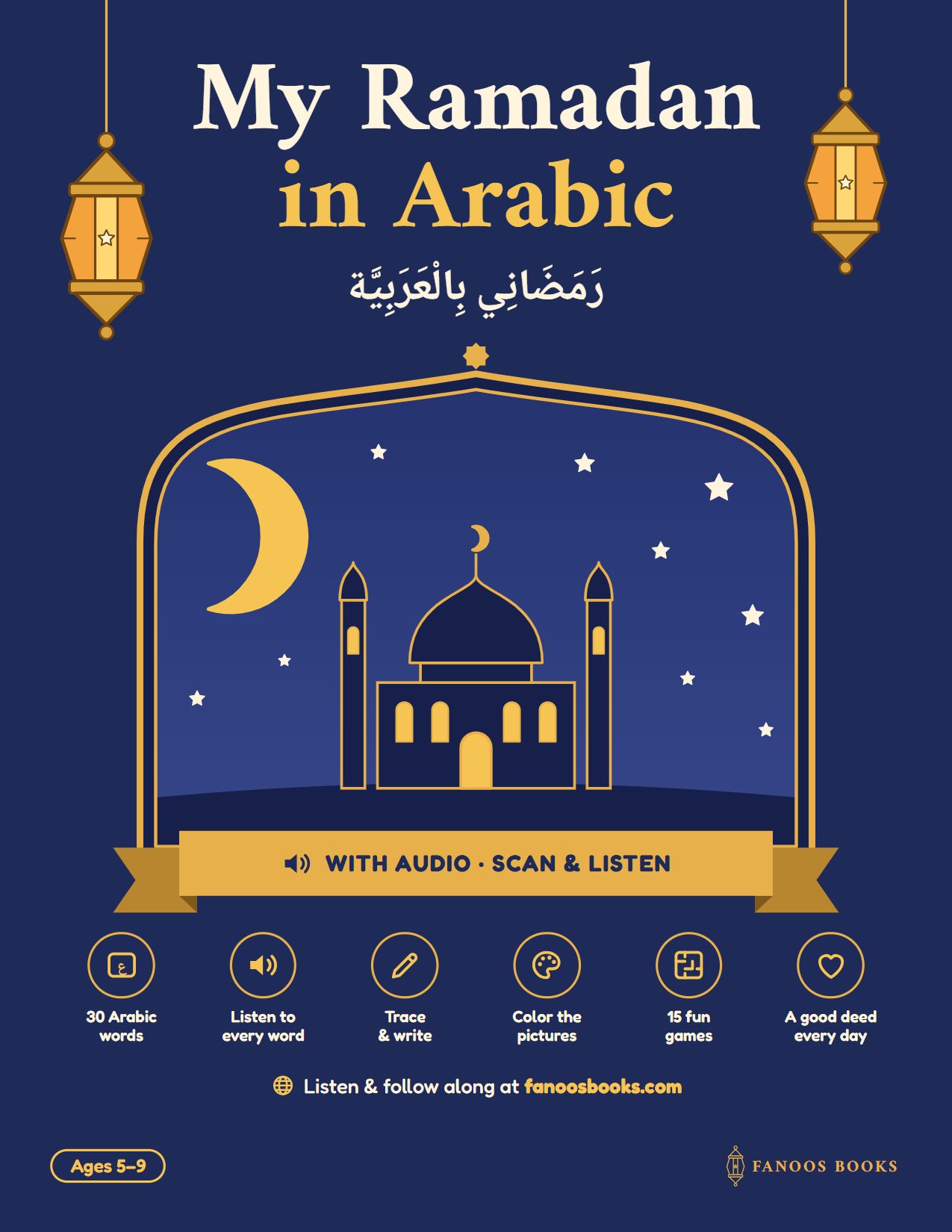
Everything in one book
My Ramadan in Arabic puts the words, the phrases, the good deeds, the games and the quiz together, one day at a time.
See the book