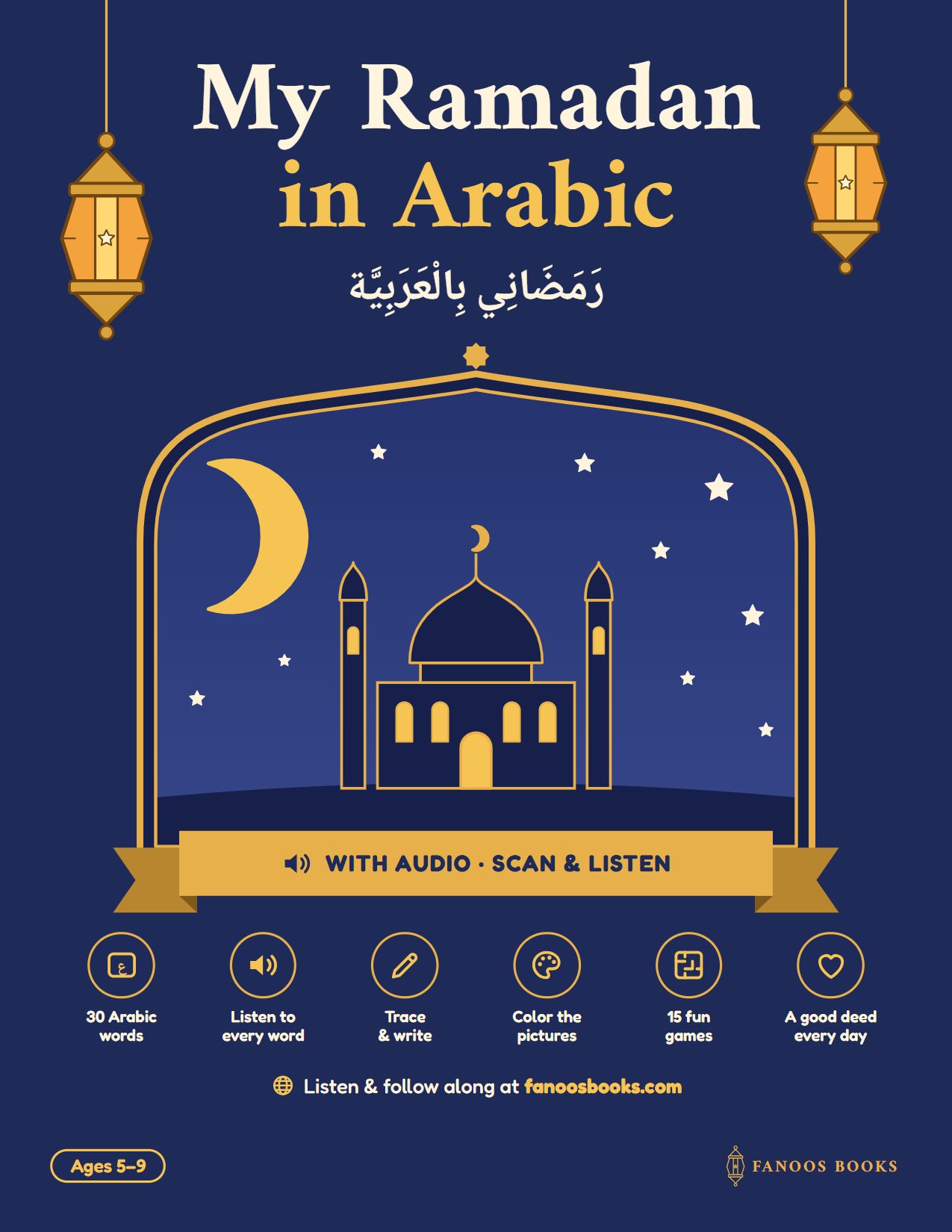
Give your child one Arabic word for each day of Ramadan and spend about ten minutes with it: hear it, say it slowly, trace it, color it, learn a short phrase and do a good deed. By Eid your child knows 30 words, and you don't need to speak Arabic to do it.
Why Ramadan is a good month to start
Ramadan comes with its own words, and children hear them all month: suhoor before dawn, iftar at sunset, taraweeh at night, Eid at the end. Learning a word the day it happens around them makes it stick.
The month also gives you a rhythm: 30 days, 30 words, from the new crescent on the first night to Eid. Each word is small enough for one evening, and the routine itself becomes part of Ramadan.
The ten-minute routine
1. Hear it
Scan the code to hear today's Arabic word. Play the word two or three times. Children learn a language by ear first, long before they can read it.
2. Say it slowly
Say the word one part at a time. Clap once for each part. Say the louder part (in capitals in our guide) a little louder, the way Arabic speakers do.
3. Trace and write
Trace the grey word, then write it yourself. Start on the right: Arabic is written from right to left. For younger children, tracing the grey word once is enough.
4. Color
Color today's picture. While they color, name what is in the picture, and use the Arabic word in a sentence: “Look, the hilaal is in the sky!”
5. Say it today
Learn a greeting, a dua or a verse of the Quran. Learn the phrase of the day and use it for real: say “Bismillaah” before eating, “Shukran” after help.
6. Do a good deed
Do it, then tick the box. Pick a deed they can finish today, then tick the box together at iftar.
How to read the pronunciation
Our pronunciation guide uses English letters, so any parent can read it aloud:
| You see | It means |
|---|---|
| aa · ee · oo | long vowels, as in hi-LAAL and sa-HOOR |
| ' | the letters ع and ء, as in du-'AA' |
| CAPITALS | the part of the word you say louder, as in ra-ma-DAAN |
| ← | Arabic is read from right to left |
Tips by age
Ages 5 and 6
- Focus on hearing and saying the word. Reading and writing can wait.
- Color together and talk about the picture, using the Arabic word.
- Choose a good deed you can do together the same day.
Ages 7 to 9
- Ask them to trace the word, then write it once on their own.
- Point to each letter and say its name: our word pages show every letter and the shape it takes.
- Turn it around at iftar: let them quiz you on yesterday's word.
If you don't speak Arabic
You don't need to. Play the recording first and repeat after it together, so your child hears a native speaker, not just you. Don't worry about sounds that have no English equivalent, like ع or ح: say them as best you can and keep going. Children are often quicker at these sounds than adults, and enjoy correcting their parents.
The 30 words, week by week
Week 1: the month begins
Week 2: fasting days
Week 3: the nights of Ramadan
Keep it fun
- Print a free coloring page with the word to trace.
- Try the Islamic quiz for kids after iftar.
- Learn a Ramadan greeting or dua and use it the same day.
- Pick a good deed to go with each word.
- Learn the letters of the word of the day.
Questions
Can my child learn Arabic if we don't speak it at home?
Yes. Start with words your child already hears in Ramadan, like iftar, suhoor and Eid, and use recordings so they hear a native speaker. A pronunciation guide in English letters lets parents learn alongside their children.
How long should we spend on Arabic each day?
About ten minutes is enough for children aged 5 to 9: one word, heard, said, traced and colored, plus a short phrase. A little every day works better than a long session once a week.
What age is right to start?
From about five, children can hear, repeat and color a word a day with a parent. From seven, most can trace and write the word and start reading it on their own.