Islam for kids: prayer, wudu, duas and Allah, age by age
10 answers for parents on everyday Islam, from a toddler on the prayer mat to a 10-year-old who prays on their own.
Children learn their religion first by doing it beside you, then step by step, then on their own. Little ones learn prayer by standing next to you on their own mat and copying your movements, praised for joining in rather than for getting every movement right. Scholars commonly advise starting to teach the steps of prayer around seven, which leaves years to teach it in small pieces before it becomes a duty; from about ten, the work is keeping it up, five times a day, when you are not there to remind them.
The same pattern works for the rest. Wudu is taught side by side at the sink, one step a day. Everyday duas stick when each one is tied to a moment that already happens: Bismillah before meals, the sleep dua at lights-out, the leaving-home dua at the front door. Manners, adab, are learned mostly by watching you, one a week, practiced in real moments. The five pillars become things your family does together, not only a list to recite.
For the biggest question, who Allah is, little children need short, true sentences about what they can see and feel: Allah made the moon and the rain, Allah hears you, Allah never sleeps, Allah is the Most Merciful. From about six, they want reasons, and His names, one a week, give them. Islamic history fits here too, told as the stories of real people, one a week.
Each answer below links every verse to quran.com and every hadith to sunnah.com. Start with the first one, or with your child’s age.
Questions parents ask: Islam for kids
10 questions, youngest first. Each opens with a short answer, then a routine, what changes with age and the sources.
- Start here
How do I teach my 3- to 6-year-old to pray?
Ages 3–6: a mat of their own, copying you, and no corrections yet.
Read the answer -
How do I explain Allah to my 3- to 5-year-old?
Ages 3–5: short true sentences about what they can see and feel.
Read the answer -
How do I teach my child everyday duas?
One dua a week, tied to its moment, with Arabic, meaning and source.
Read the answer -
How do I teach my child Islamic manners (adab) at home?
One manner a week, practiced in real moments, modeled by you.
Read the answer -
How do I teach my child wudu?
Side by side at the sink, one step a day, right side first.
Read the answer -
How do I teach my kids the five pillars of Islam?
Five pillars, five things to do together, one a week.
Read the answer -
How do I answer my 6- to 9-year-old’s questions about Allah?
Ages 6–9: His names, real answers, and trust on hard days.
Read the answer -
How do I teach my 7- to 9-year-old the steps of prayer?
Seven to nine: one step at a time, shown before it’s explained.
Read the answer -
How do I teach my child about Islamic history and Muslim scholars?
One person a week, told as a story, honest about the facts.
Read the answer -
How do I get my child to pray regularly from age 10?
Ten and up: fixed moments, their own plan, and no nagging.
Read the answer
Free to use with your child
Pages already on this site that go with these answers, free for home and the classroom.
- In Arabic
Ramadan greetings and duas
Ramadan Mubarak, the dua for breaking the fast, Eid Mubarak and more, with meanings and sources.
Learn the phrases - Checklist
30 Ramadan good deeds for kids
One small good deed for each day, with boxes to tick and a free chart to print.
See the 30 deeds - Free printables
Coloring pages, charts and trackers
Ramadan coloring pages with Arabic words to trace, a good deeds chart, a moon tracker and alphabet worksheets.
Print them
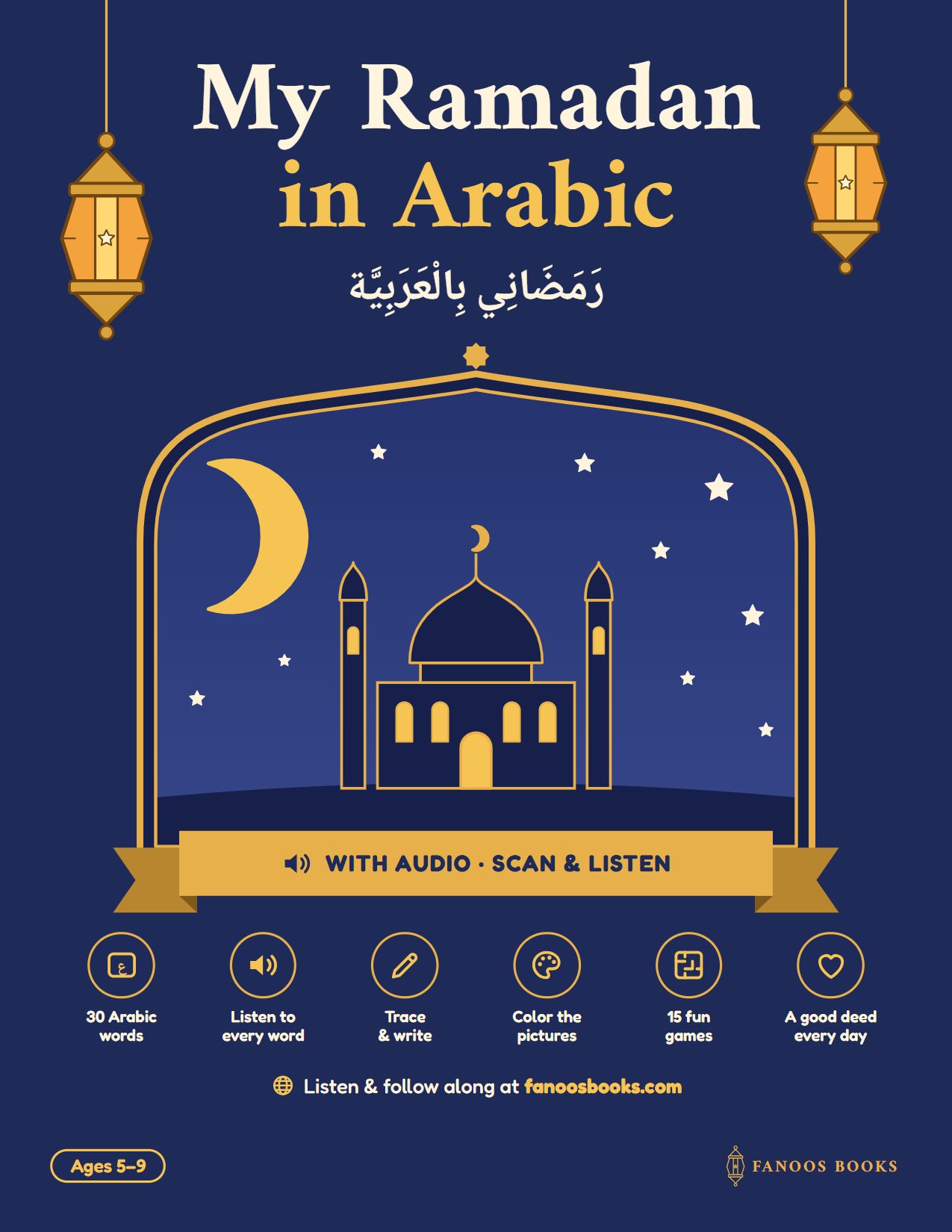
Everything in one book
My Ramadan in Arabic puts the words, the phrases, the good deeds, the games and the quiz together, one day at a time.
See the book